What to Do When Markets Are Volatile: An Investor’s Guide

What to Do When Markets Are Volatile: An Investor’s Guide

By Akhil Chugh
Date Jan 26, 2026

Market volatility has become a recurring feature of today’s global financial landscape. Equity markets are reacting sharply to frequent geopolitical and economic developments—ranging from renewed trade tensions and tariff announcements by the United States to unexpected strategic statements, such as discussions around acquiring Greenland. These events add uncertainty to global supply chains, currency markets, and investor sentiment, resulting in heightened market swings.

For investors, the key question is not why markets are volatile, but how to respond. History shows that disciplined investing—especially through Systematic Investment Plans (SIPs) in mutual funds—remains one of the most effective strategies during turbulent periods.

Common Investor Mistakes During Volatile Markets:
  • Stopping SIPs after short-term losses
  • Attempting to time the market
  • Shifting entirely to cash after sharp corrections
  • Reacting to daily news instead of long-term fundamentals

These actions often result in locking in losses and missing subsequent recoveries.

Why SIPs Work Well in Volatile Times?

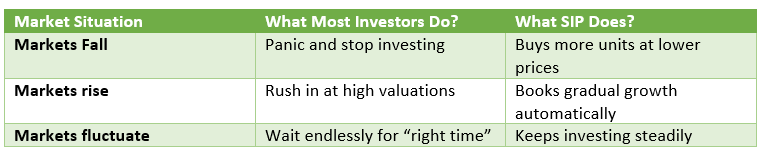
A Systematic Investment Plan (SIP) allows investors to invest a fixed amount at regular intervals, regardless of market levels. This structure offers three critical advantages during volatility:

1. Rupee Cost Averaging

When markets fall, the same SIP amount buys more units; when markets rise, it buys fewer units. Over time, this lowers the average cost per unit.

 2. Discipline Over Emotion

SIPs remove the need to make repeated investment decisions, protecting investors from emotional reactions to negative headlines.

 3. Compounding Over Market Cycles

Staying invested through market ups and downs allows compounding to work uninterrupted.

Here’s how SIPs help when the market acts unpredictable:

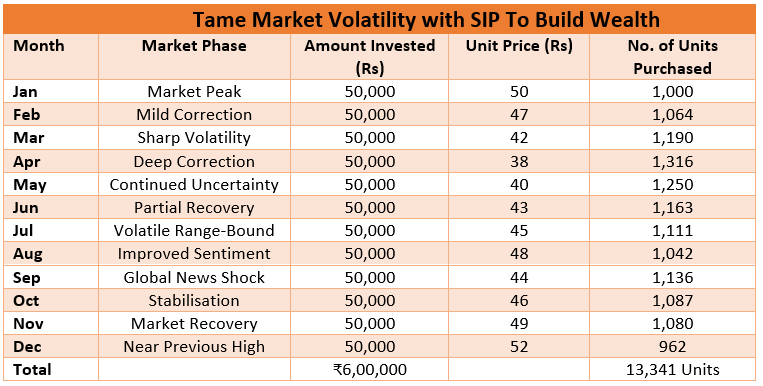
Illustrative Example: ₹50,000 Monthly SIP During a Volatile Year

What This Shows?

  • Total Amount Invested (via SIP): ₹6,00,000
  • Average Cost per Unit: ₹44.97
  • Total Units Purchased: 13,341

Now, let’s compare this with someone who invested ₹6,00,000 as a lump sum in January, when the unit price was ₹50:

The Result:

If by the end of the year, the unit price rises to ₹52:

Difference in Gain = ₹69,732 more!

When markets fall, SIPs buy more units — and when markets rise, those extra units multiply your returns. That’s how SIPs help you tame volatility and build wealth automatically, without the stress of timing the market.

How Investors Should Position SIPs During Volatility
  • Continue existing SIPs instead of pausing them
  • Increase SIP allocations selectively if cash flows permit
  • Maintain proper asset allocation across equity, debt, and hybrid funds
  • Review portfolio alignment with goals—not short-term market noise

Volatile markets often present opportunities disguised as uncertainty for disciplined investors.

Conclusion:

Market volatility driven by global events, including aggressive policy statements and geopolitical uncertainty, is unavoidable. However, reacting emotionally is optional. SIPs in mutual funds remain one of the most effective tools to navigate volatility, leveraging market fluctuations to an investor’s advantage.

The most successful investors are not those who predict markets correctly, but those who remain disciplined when markets are uncertain.

Unsure how to navigate volatile markets? Speak with our finance professionals and align your SIP with your goals.

Download our mutual fund app & start investing for your long-term financial goals.     

Happy Investing!