

By Akhil Chugh
Date March 02, 2026
When you start investing, one of the first terms you’ll hear is risk appetite. It sounds technical, but it’s actually very simple: it is the amount of uncertainty you are comfortable handling when you invest your money.
While some investors are comfortable with market swings, others feel stressed by even small fluctuations. There is no “right” type, but understanding your own profile is the foundation of smart investing.
What Is Risk Appetite?
Risk appetite is the amount of risk you are willing and able to take in pursuit of returns. It essentially answers one question: How much volatility can you tolerate without panicking or making poor decisions? including India. Equity markets may witness short-term corrections.
Consider two people investing ₹10 lakh:
Investor A: Sleeps peacefully during a 15% market correction.
Investor B: Exits in a panic after a mere 5% drop.
Same investment. Different risk appetite.
Why Risk Appetite Matters in 2026
In the current 2026 market landscape, alignment is critical due to several factors:
Global Interest Rates: The most recent Federal Open Market Committee (FOMC) decision in January 2026 kept the rate at 3.50%–3.75%.
India’s Growth Story: India remains a powerhouse with GDP growth projected around 6–7%.
Record Participation: As of January 2026, retail SIP inflows have surged above ₹31,000 crore per month.
Volatility: Despite strong fundamentals, markets can still correct 10–15% due to global shocks, oil prices, or currency volatility.
Investor Profiles & Typical Allocations
Understanding your category helps determine your ideal portfolio mix:
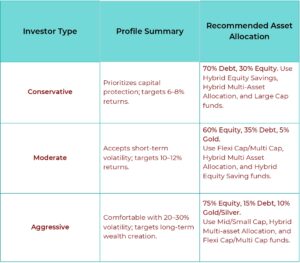
Note: An aggressive profile only works if an emergency fund is in place and there is no short- term liquidity pressure
Risk Appetite vs. Risk Capacity
- Risk Appetite (Psychological): Your emotional tolerance. “Can I sleep at night?”
- Risk Capacity (Financial): Your mathematical ability to lose money. “Can I afford the loss?”
For example, a 28-year-old has high capacity (time is on their side) but may have a low emotional appetite. A 55-year-old nearing retirement has a lower capacity and must protect capital, even if they feel emotionally aggressive.
The 2026 Practical Test
To find your true alignment, ask yourself:
- If my portfolio falls 10% in 6 months, will I exit, wait, or invest more?
- Do I have a 6–12 month emergency fund and adequate insurance?
- Do I need this money within the next 3 years?
If your answers are uncertain, you are likely a moderate investor, not an aggressive one.
The Money Monday Perspective
In 2026, returns, volatility, and opportunities will all exist. Markets reward discipline, not just bravery. The biggest risk isn’t a market dip—it’s abandoning a sound strategy because it didn’t match your personality.

