

How Global Market Trends Could Shape Indian Investments

By Akhil Chugh
Date Feb 24, 2026
In today’s interconnected world, markets don’t move in isolation.
What happens in the United States, Europe, or China can quietly influence your mutual fund portfolio. Even if you invest only in Indian mutual funds, global events quietly influence your portfolio.
A policy change in the US, a slowdown in China, a spike in oil prices, or geopolitical tensions in Europe, all of these can ripple through Indian markets.
But how exactly does this happen? Let’s understand.
Global Interest Rates & Capital Flows
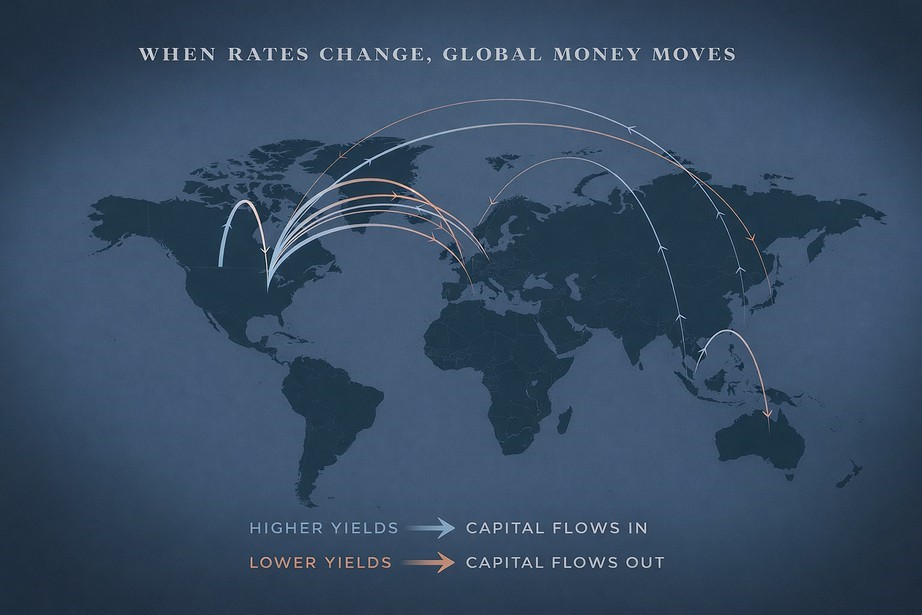
One of the biggest global drivers is interest rate movement, especially in the United States.
The U.S. Federal Reserve cut its benchmark rate by 25 bps multiple times through 2025, bringing the policy rate down to about 3.5–3.75% by early 2026. Markets are now pricing in potential further Fed rate cuts in 2026, depending on inflation and growth data.
- When developed economies like the US increase interest rates:
- Global yields on safe assets (like U.S. Treasuries) rise → risk appetite drops.
- Liquidity tightens, encouraging capital to move away from higher-growth emerging markets, including India.
- Equity markets may witness short-term corrections.
On the other hand, when global interest rates fall:
- Liquidity increases globally.
- Emerging markets attract foreign investments.
Equity markets tend to benefit.
Why this matters to Indian investors:
FIIs hold roughly 25–26% of major Indian equities, meaning their flows influence market direction. Their buying or selling can create volatility. However, volatility does not always mean weak fundamentals. It often reflects global money movement rather than domestic weakness.
Crude Oil Prices & Inflation
India continues to be heavily dependent on imported crude oil; around 88–90% of its consumption is met through imports. Because of this, global oil prices directly impact our economy.
In Dec 2025, India’s crude oil import bill from Russia was about $2.7 billion, down from previous months due to sanctions, but Russia still remained the largest supplier in 2025- 26 at ~31.5% of total crude import value (April–Dec).
When oil prices rise:
- Brent crude has trended up near ~$70+ per barrel in early 2026 amid geopolitical tensions. Rising crude prices put upward pressure on inflation because India imports almost all its oil, which pushes up fuel and transport costs.
- A weaker rupee further amplifies inflation. Analysts estimate that a 1 ₹ depreciation can add ~0.2–0.3% to inflation via higher import costs.
- RBI may respond to persistent inflation by raising interest rates or delaying rate cuts to control inflationary risks. (Implied by RBI policy context)
When oil prices fall:
- Easing oil prices can reduce headline inflation over time if sustained.
- Lower oil import costs improve India’s fiscal and current account positions.
- Cheaper fuel can support consumption growth as households have more disposable income.
What investors should note:
Oil prices feed directly into inflation — higher oil → higher inflation → RBI could tighten monetary policy or slow rate cuts.
Understanding this connection helps in asset allocation decisions.
Global Tech Cycles & Indian IT Stocks
Many Indian companies earn revenue from overseas markets. For example:
IT companies depend heavily on US and European clients. As of FY 2025–26, leading Indian IT firms derive ~75–85% of their revenue from overseas markets, with 55–65% coming from the US alone and another 20–25% from Europe.
Pharma companies export globally. India exports medicines to 200+ countries, and the US accounts for roughly 30–35% of total Indian pharma exports (FY25 data). The pharmaceutical export market size is estimated at ~$28–30 billion annually.
Specialty chemical manufacturers cater to international demand. India’s specialty chemical exports crossed $30+ billion, with strong demand from Europe, US, and China.
If global growth slows:
- Export demand weakens.
- Earnings growth may slow temporarily.
- Sectoral mutual funds may underperform.
If global growth strengthens:
- Earnings visibility improves.
- Export-oriented sectors benefit.

Key learning:
India’s Nifty IT index is highly correlated with US tech spending trends.
Diversified equity funds, with exposure across domestic consumption, banking, manufacturing, and exports, may cushion global shocks better than narrowly focused sector funds.
Global Recession Fears
Currency plays an important role in global investing, especially for an import-dependent economy like India.
As of early 2026, the US Dollar Index (DXY) has remained elevated in the 103–106 range, reflecting global risk aversion and relatively stronger US economic positioning.
Meanwhile, the Indian Rupee has traded in the ₹88–₹90 per USD range during FY25–26, with periodic pressure during global volatility phases.
When the US dollar strengthens:
- The Indian Rupee may depreciate.
- Import costs rise. A ₹1 depreciation can increase India’s annual import bill by thousands of crores.
- Companies with foreign debt may face higher repayment burdens.
- Export-oriented companies may benefit. Many large IT firms earn 75–85% of revenue in USD, so a weaker rupee can improve margins.
When the Rupee strengthens:
- Import costs have reduced (especially oil and electronics imports).
- Inflation pressure may ease.
- India’s current account deficit may narrow.
- However, export-oriented companies may see mild margin compression.

For mutual fund investors:
- Currency movement can create both risks and opportunities, depending on sector exposure.
- It influences: Oil prices → Inflation → RBI policy → Corporate earnings → Mutual fund performance.
Currency Movements (USD vs INR)
Wars, trade tensions, global elections, and supply chain disruptions continue to influence currency markets.
As of early 2026:
- The US Dollar Index (DXY) has been trading in the 103–106 range, reflecting safe-haven demand amid geopolitical uncertainty.
- The Indian Rupee has moved within a ₹88–₹90 per USD band in FY25–26, with periodic volatility during global risk-off phases.
- Currency volatility of 2–4% annually has been typical in recent years.
Often, markets react sharply in the short term. But history shows that over time, strong economies adapt and recover.
India’s structural strengths, i.e., strong domestic demand, digital growth, and a young population, provide resilience during global uncertainty.

What Should Indian Investors Do?
Instead of reacting to every global headline or market fluctuation, investors are better served by focusing on disciplined, time-tested principles. Maintaining a well-balanced asset allocation across equity, debt, and gold (where appropriate) helps manage risk during uncertain times.
Continuing SIPs even during periods of volatility allows investors to benefit from market corrections through disciplined accumulation. Most importantly, avoid making panic-driven decisions based on short-term global noise.
Portfolios should be reviewed periodically with a rational approach, not emotionally in response to headlines. Markets naturally move in cycles, and true long-term wealth creation rewards patience and consistency.
The Money Monday Perspective
Global trends will inevitably influence Indian markets, sometimes directly through capital flows and trade, and sometimes indirectly through sentiment and currency movements.
But successful investing does not depend on predicting global events. It depends on staying aligned with your financial goals.
Short-term volatility is temporary. Long-term discipline is powerful.
Conclusion
In an interconnected world, global developments will continue to shape market movements. But while you cannot control global events, you can control your investment behaviour.
A goal-based strategy, diversified portfolio, and consistent approach can help you navigate uncertainty with confidence. Over time, it is not global headlines but disciplined investing that builds lasting wealth.