From Tariff Turbulence to Wealth Creation: How SIPs Help You Stay the Course

From Tariff Turbulence to Wealth Creation: How SIPs Help You Stay the Course

By Akhil Chugh

Date August 10th , 2025

When global headlines turn into market jitters, disciplined investors don’t run – they stay the course.

The recent decision by former U.S. President Donald Trump to impose a steep 50% tariff on Indian exports worth billions has rattled both trade relations and investor sentiment. On August 8, 2025, Indian equity markets reacted swiftly: the Nifty 50 slipped below 24,500, falling ~161 points, and the Sensex dropped nearly 540 points.

The sell-off was led by export-heavy sectors – IT and pharma – with foreign institutional investors (FIIs) offloading positions, adding further pressure. Analysts, including Morgan Stanley and Jefferies, have warned that such tariffs could dent India’s GDP growth by up to 80 basis points and threaten nearly $87 billion worth of exports. Moody’s has already hinted at a potential 0.3% slowdown in GDP growth.

For many retail investors, this sudden volatility feels like a storm cloud over their portfolios. But seasoned wealth builders know: the best umbrella in this rain is a Systematic Investment Plan (SIP) in Mutual Funds.

Why Volatility Feels Scary—But Isn’t Always Bad?

Market corrections and volatility grab headlines because they’re sudden and visible. But short-term drops don’t always equal long-term damage. In fact, they often create entry points for disciplined investors.

When tariffs, geopolitical tensions, or interest rate shocks hit, the market tends to overreact in the short run. Prices fall sharply—sometimes beyond what fundamentals justify. For SIP investors, these dips actually buy more mutual fund units at lower NAVs, lowering their overall cost.

This is rupee-cost averaging in action.

How SIPs Turn Market Dips into Long-Term Gains?

SIPs are a prudent way to beat market volatility in the long run. Let’s understand it in detail below.

1. Rupee-cost averaging:

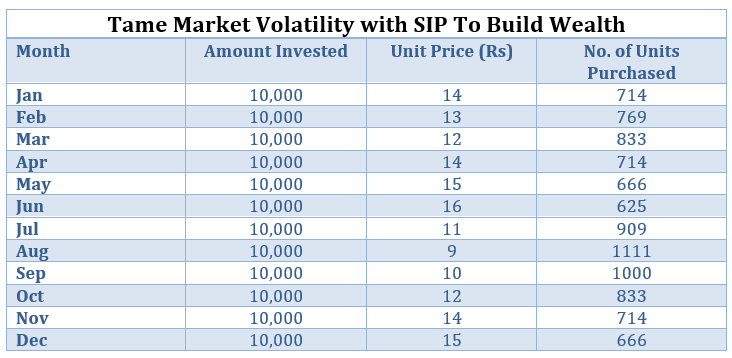
One of the most important advantages of SIP is rupee cost averaging. When you invest a fixed amount every month, the number of Mutual Fund units you actually buy depends on their market price. Therefore, with the money you invest each month, you can buy fewer units when the market moves up and more units when the market moves down. This brings down and averages the price of purchase. This in the long run enhances your returns on investment substantially.

As per the table illustrated above:

If SIP of Rs 10,000 is done throughout the year then,

Total Amount Invested Regularly for 1 year = Rs 1,20,000

Average Cost = Rs 12.6

No Of Units Purchased = 9,554

However, if Lumpsum investment of Rs 1,20,000 was done in month of Jan then,

Average Cost = Rs 14

No Of Units Purchased = 8,571

When the markets fluctuate, you may be tempted to stop/withdraw your SIP investment. But it pays to think long-term, because you can buy more units during a falling market, and also, the cost of your investments will average out over a period. Thus, in the long run, SIPs can act as a shock absorber for your investment portfolio.

2. Power of Compounding:

SIPs use the power of compounding to invest over time and through various cycles of market volatility. Compounding is when your interest earnings are added to the principal amount to increase future returns. It is called the power of compounding because you earn interest on interest. This helps to create a larger corpus in the long run. The more time your money stays invested, the harder compounding works for you.

3. Behavioral Discipline:

In volatile markets, emotions tempt investors to pause or redeem. SIPs automate the process, making it easier to stick to the plan and avoid bad timing decisions.

Tariff Turbulence: Not the First, Won’t Be the Last

Trade disputes, tariffs, currency wars—these aren’t new. The market has seen:

  • 2018–19 U.S.–China trade war
  • Brexit uncertainty
  • Oil price shocks

In every case, disciplined investors who stayed invested through the turbulence came out ahead.

Today’s Trump-imposed tariff shock is a headline event, but for a long-term SIP investor, it’s just another market cycle.

Practical Tips for Investors Right Now:

  • Stay Invested – Your SIPs are designed to work through market cycles. Stopping them defeats the purpose.
  • Review Asset Allocation – Ensure your equity-debt balance matches your risk appetite, especially if you have near-term financial goals.
  • Increase SIP Amounts in Dips – If your cash flow allows, use volatility to step up your monthly contribution.
  • Avoid Knee-Jerk Portfolio Changes – Don’t switch out of equity mutual funds purely because of short-term tariff news.

 Conclusion:

Tariff turbulence is testing patience right now. But SIP investors who understand the long game know that every downturn plants the seeds of future returns.

Staying invested, trusting rupee-cost averaging, and letting compounding do its work will ensure that when the clouds of trade disputes pass—and they will—you’ll be standing stronger, with your wealth having grown through the storm.

Have questions about your investments or SIP strategy?

Call us today—let’s ensure your portfolio is built to weather every storm and seize every opportunity.

Download our mutual fund app & start investing for your long-term financial goals.     

Happy Investing!